


11
2026
-
11
How to evaluate a vegetarian capsule bulk supplier beyond price and MOQ
Article overview
A vegetarian capsule bulk supplier sells empty plant-based capsule shells, such as HPMC or pullulan, in commercial quantities. This 2026 guide shows UK buyers how to judge a vegetarian capsule bulk supplier on material, certification, testing, logistics and total cost, not only price and MOQ. It includes a step-by-step process, data tables and a worked scenario.
Table of contents
- 1. Why price and MOQ do not tell the full story
- 2. Material and specification checks that matter
- 3. Certifications and compliance for the UK market
- 4. Quality control, testing and machine performance
- 5. Supply chain, lead times and private label support
- 6. A step-by-step process to evaluate a vegetarian capsule bulk supplier
- 7. Making the final decision
- 8. Frequently asked questions
Price and minimum order quantity (MOQ) are the first numbers every buyer compares. They rarely decide whether a capsule programme succeeds, though. The real question is whether your vegetarian capsule bulk supplier can deliver identical, compliant shells batch after batch, on time, with paperwork that survives an audit.
This 2026 guide gives UK supplement brands, start-up founders and procurement teams a practical framework. It draws on checks commonly used when qualifying a packaging component, and it admits where judgement, rather than a rule, has to decide. Prices appear in pounds sterling (£) and sizes in metric units.
Why price and MOQ do not tell the full story
Price and MOQ describe the cost of entry, not the cost of ownership. A cheap quote that delivers brittle, sticky or poorly locking shells will cost far more on your filling line than it saved at purchase.
What a vegetarian capsule bulk supplier actually provides
A vegetarian capsule bulk supplier is a company that makes or distributes empty plant-based capsule shells in commercial volumes, backed by specifications, certificates and batch records. Typical ranges include HPMC capsules wholesale, pullulan capsules supplier lines and cellulose capsules bulk buy programmes. Customers range from small brands to contract fillers. When reviewing supplier files, the strongest candidates behave less like traders and more like technical partners: they answer specification questions quickly and put the answers in writing.
Why is the cheapest quote often not the lowest cost?
Because unit price ignores rejects, stoppages, retesting and delay. Two quotes that look identical on paper can diverge sharply in practice. Common hidden costs include:
- Shell defects such as dents, split caps and telescoped pairs that raise line-loss
- Moisture drift that causes brittleness in dry conditions or softening in humid storage
- Missing or outdated certificates that delay a product launch
- Variable lead times that leave filling lines idle
- Retesting costs when batch data are inconsistent
MOQ deserves the same scepticism. A low MOQ helps a start-up's cash flow, yet it can signal a stockholding distributor whose cartons come from several production lots. A high MOQ may come with a tighter specification. Neither is automatically better. What matters is traceability back to the original manufacturing batch, and whether your chosen vegetarian capsule bulk supplier will confirm it in writing.
Most buyers underestimate how often the capsule is the weakest link. Powders and blends get the attention, yet the shell touches every unit sold. Think of it as the foundations of a house: invisible once built, catastrophic if wrong. A pattern seen repeatedly in sourcing projects is a founder who picks the lowest quote, then spends the saving, and more, on rework when the first lot jams a filling machine.
So what does "beyond price and MOQ" mean in practice? Five dimensions carry most of the risk: material and specification, certification, quality control, supply reliability and service. The sections below take each in turn, and a weighted scorecard near the end turns judgement into a comparable number.
Of course, price still matters. Margins in supplements are tight, and a 10% difference on a million-capsule order is real money. The point is sequence: qualify first, then compare prices only among suppliers who pass.
Material and specification checks that matter
Start with material, then lock down size and tolerances. HPMC suits most vegetarian and vegan formats, while pullulan is often chosen for oxygen-sensitive fills. Put every parameter into a signed specification.
Is HPMC or pullulan better for vegan supplements?
Neither wins universally. Hypromellose (HPMC) is a cellulose-derived polymer, and the hypromellose capsule material record on PubChem sets out its chemical identity and synonyms. Pullulan is a polysaccharide produced by fermentation. Both are gelatine-free, so both fit a vegan capsules bulk supplier brief, but they behave differently on the line and in storage. For wider context, see this overview of vegetarian capsule types. Table 1 summarises typical differences.

Table 1: typical material characteristics
| Property | HPMC | Pullulan | Gelatine (reference) |
|---|---|---|---|
| Origin | Cellulose | Fermented polysaccharide | Animal collagen |
| Vegetarian or vegan suitable | Yes | Yes | No |
| Typical moisture content | About 4–6% | Request COA data | About 13–16% |
| Brittleness when very dry | Lower risk | Request data | Higher risk |
| Oxygen barrier | Moderate | Often cited as low permeability | Good |
These are typical ranges from published technical literature, so confirm every figure against the supplier's certificate of analysis (COA). One nuance: some HPMC shells use a gelling agent, while others are gel-free. For gelatine-free capsules wholesale programmes, ask which system applies, because it can affect dissolution behaviour and should be reflected in the shell's ingredient declaration.
Which sizes and tolerances should you specify?
Specify size 00 vegetarian capsules bulk and size 0 veggie capsules wholesale by dimensions, not just by name. Table 2 shows approximate capacities; actual fill weight depends on powder density and tamping.
Table 2: approximate capsule capacity by size
| Size | Typical volume (ml) | Approx. fill at 0.8 g/ml (mg) |
|---|---|---|
| 00 | 0.91 | 730 |
| 0 | 0.68 | 540 |
| 1 | 0.50 | 400 |
| 2 | 0.37 | 300 |
| 3 | 0.30 | 240 |
| 4 | 0.21 | 170 |
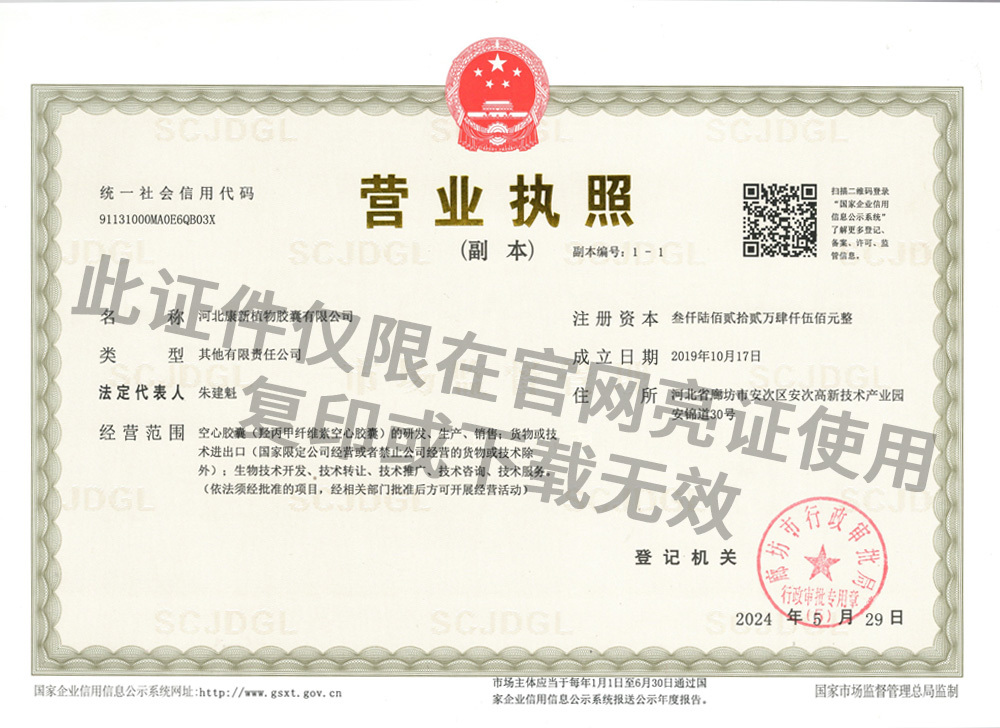
Ask for locked length, body and cap diameters and wall thickness tolerances, plus loss on drying, disintegration time, heavy metals and microbial limits. Hebei Kangxin Plant Capsule Co., Ltd., for example, publicly lists HPMC capsules in sizes 00#, 0#, 1#, 2#, 3# and 4#. A range like that is a useful starting point for empty vegan capsules for supplements, but each dimension still needs a signed specification from your vegetarian capsule bulk supplier.
In practical filling trials, shell moisture shows up first as handling symptoms. Overly dry shells crack in hoppers; overly moist ones stick or deform during polishing. Ask the vegetarian capsule shells manufacturer for storage guidance and shelf-life data, then confirm your warehouse can meet it. Colour matters too, for branding and light protection. Request colourant lists, check that colourants comply with permitted-additive rules, and ask whether the shells contain titanium dioxide, since it remains an active regulatory topic.
Certifications and compliance for the UK market
Ask for current, verifiable certificates covering manufacturing quality, food safety and dietary status, then check issuing bodies and expiry dates yourself. A claim without a certificate is only a claim.
What certificates should a vegetarian capsule bulk supplier hold?
Reasonable requests include evidence of GMP (good manufacturing practice) suited to pharmaceutical excipients or food contact materials, ISO 9001 or ISO 22000, and a recognised food safety scheme such as BRCGS or FSSC 22000 where relevant. Verify certificate numbers in the certification body's public directory. Treat a missing certificate as an open question rather than an automatic rejection, since some manufacturers hold equivalent national credentials that an audit can assess. A web page headed "Qualifications and honours" with no certificate copies, however, proves nothing. Also request:
- A batch-specific COA
- Allergen, GMO and animal-derived-input statements
- Residual solvent, heavy metal and microbial limits
- A commitment to notify you of process or material changes
Watch for red flags: a certificate with no site address or expiry date, reluctance to share a sample COA before payment, or different company names on the certificate and the invoice. A standard pre-qualification questionnaire makes this easier. Ask for site address, ownership, audit history, complaints procedure and recall plan.
How should halal, kosher and vegan claims be verified?
Halal kosher certified vegetarian capsules widen retail options, but the certificate must name the manufacturing site and product and come from a body your retail customers accept. Vegan claims need a written statement that no animal-derived inputs, processing aids or lubricants are used. Many UK brands also pursue The Vegan Society trademark at finished-product level, which depends on every ingredient, not the shell alone.
Which UK regulatory points affect imports?
Hypromellose is E464 and pullulan E1204 in food additive numbering, and specifications derive from Commission Regulation (EU) No 231/2012 as retained in GB law. Guidance from the Food Standards Agency and your regulatory adviser should confirm how that applies to your product. Importers should also confirm the commodity code (heading 9602 is commonly used for empty capsules), the Incoterms and who acts as importer of record. Rules change, so check current guidance on GOV.UK before shipping.
Quality control, testing and machine performance
Request batch COAs, run your own trials on your actual filling equipment, and add independent testing before committing to volume. Paper quality and line quality are different things.
What should the supplier's QC system include?
Look for in-process dimensional checks, defined sampling plans (for example AQL-based visual inspection), lot traceability, retained samples and a formal change-control procedure. Pharmaceutical guidance puts the principle bluntly:
"Quality cannot be tested into products; i.e., quality should be built in by design." — ICH Q8(R2), Pharmaceutical Development
In practice, that means a vegetarian capsule shells manufacturer should show you how it controls raw material, moulding and drying, not merely how it inspects the final carton.
How should you test samples before a bulk order?
Request samples from at least two different production batches and run a trial of several thousand capsules on your own machine. Record lock rate, split caps, dents, powder leakage and downtime. Hard capsule disintegration is normally assessed against a pharmacopoeial limit (commonly 30 minutes), but confirm the current monograph for your market. Agree acceptance criteria in advance:
- Maximum split-cap and dent rate per 10,000 capsules
- Minimum correct lock rate at your running speed
- No powder leakage after standard handling
- Disintegration within specification
- Consistent shell weight across lots
Machine compatibility claims need context. Some manufacturers state that their shells suit a wide range of domestic and international filling machines, and one profile I reviewed cites a pass rate above 99.9%. Treat such figures as company claims. Ask for the machine model, speed, sample size and test conditions behind them.
Storage and packaging need equal attention. Shells normally arrive in food-grade liners inside cartons, so ask about humidity control, pallet stacking limits and shelf life. Record warehouse temperature and humidity on arrival, since conditions in transit can shift moisture content.
When is independent laboratory testing worth it?
Almost always for the first order. A UKAS-accredited laboratory can verify moisture, disintegration, heavy metals and microbial counts independently of the supplier's COA. Budget a few hundred pounds per panel (quotes vary); that is a small premium against a failed production lot. If a supplier has delivered consistent results for years, you may reduce testing to periodic verification.
Supply chain, lead times and private label support
A dependable partner states capacity, lead times and packaging terms in writing and can support UK-specific logistics. Vague answers about delivery are an early warning sign.
How do you test capacity and continuity claims?
Hebei Kangxin Plant Capsule Co., Ltd. states an annual capacity of 10 billion capsules, 20 years of plant-based R&D and a 2019 founding date. Statements like these are a starting point, not proof. Ask any vegetarian capsule bulk supplier for line numbers, shift patterns, raw material sourcing, safety stock policy and the typical lead time for a one-million-capsule order. Sea freight from Asia to UK ports commonly takes several weeks before customs clearance, so plan buffer stock. Why gamble a product launch on an optimistic delivery promise?
Trade terms deserve a line-by-line read. Under EXW you manage collection and export clearance; under FOB the supplier delivers to the vessel; under DDP the supplier handles UK import formalities, which simplifies life for small brands but should be priced transparently. Whichever you choose, define who is liable for transit damage and who pays for rejected lots.
Should you choose a UK or overseas supplier?
It depends on your priorities. A plant-based capsule manufacturer UK or a UK stockholder can offer shorter lead times, smaller drops and easier returns, which suits vegetable capsules wholesale UK buyers testing a new product. Direct manufacturing overseas often offers lower unit cost and tighter control of specification at higher volumes. Many brands use both: a local stockholder for launch, then direct supply once demand stabilises.
What does private label support involve?
A private label capsule supplier UK arrangement can include radial printing with your logo, colour matching, inner liners, labelled cartons, batch coding and desiccant. Clarify the minimum print run, artwork approval process and tooling cost before you commit. Confirm payment terms too, as deposits for custom printing are common. For bulk empty capsules for supplement manufacturers, also ask whether cartons can be labelled with your own item codes.
Responsiveness is a quality signal as well. Send a technical question about locked-length tolerance and time the reply. Clear, specific answers within two working days suggest a functioning technical team; evasive ones suggest the opposite. Time zones add delay, of course, so compare like with like.
A step-by-step process to evaluate a vegetarian capsule bulk supplier
Work in stages: shortlist on paperwork, test samples, audit, then negotiate on total cost. This sequence stops you spending time on suppliers who fail early.
Seven steps from shortlist to contract
- Define requirements: material, size, colour, annual volume, certificates and delivery location.
- Send a standard request for quotation (RFQ) to three to five candidates so replies are comparable.
- Screen documents: certificates, sample COA, specification sheet and allergen statements.
- Order samples from at least two different batches of each size.
- Run line trials and independent laboratory tests against pre-agreed criteria.
- Audit by video walk-through, third-party report or site visit, and review a real batch record.
- Compare total landed cost, then sign a quality agreement alongside the commercial terms.
Step six deserves emphasis. An audit need not be expensive: a structured video tour of moulding, drying, inspection and warehouse areas, followed by a batch record review, exposes most weaknesses. Ask to see a real record, not a template. Negotiate last, with data in hand. Use your results to request price breaks, longer payment terms or call-off schedules, and insist on a written quality agreement covering specification, change control, complaint handling and recall cooperation. That protects you more than a small discount does.
How should you weight the criteria?
Table 3 offers a starting scorecard. Adjust the weights to your risk profile; a highly regulated product may justify raising certification.
Table 3: weighted supplier scorecard
| Criterion | Weight | Evidence to collect |
|---|---|---|
| Specification and quality | 25% | Signed specification, batch COAs |
| Certification and compliance | 20% | Verified GMP, ISO, halal, kosher, vegan statements |
| Machine performance | 20% | Trial lock rate, rejects, downtime |
| Total landed cost | 15% | Unit price, freight, duty, testing |
| Lead time and reliability | 10% | Written lead times, capacity answers |
| Service and private label | 10% | Response time, printing options |
Illustrative scenario: total cost of a one-million-capsule order
The figures below are hypothetical, built to show the method; they are not from a real client. Imagine a UK start-up ordering 1,000,000 size 00 shells at a headline £6.50 per 1,000.
Table 4: hypothetical total cost calculation
| Item | Amount |
|---|---|
| Capsules (1,000,000 at £6.50 per 1,000) | £6,500 |
| Freight, duty and clearance (assumed) | £480 |
| Independent testing (assumed) | £350 |
| Samples and line trial (assumed) | £120 |
| Total spend | £7,450 |
| Usable capsules after 1.5% line-loss | 985,000 |
| Effective cost per 1,000 usable | about £7.56 |
The effective price rises from £6.50 to about £7.56 per 1,000 usable capsules, roughly 16% above the headline. Each extra percentage point of line-loss adds about £0.08 per 1,000. Run this arithmetic with your own numbers before negotiating, because it moves the conversation from price to value.
Making the final decision
Qualify on evidence, then compare cost. The right supplier is the one whose proof, performance and paperwork match your product's risk.
Key points to remember
- Unit price and MOQ are inputs, not conclusions.
- Verify certificates and treat company claims, including capacity and pass rates, as questions to test.
- Trial every size on your own line and confirm results in an independent laboratory.
- Judge suppliers on total landed cost, lead time reliability and service.
Next steps for your sourcing project
Choosing a vegetarian capsule bulk supplier is a quality decision first and a pricing decision second. Shortlist two or three candidates, request samples from separate batches and score them with the table above. When you are ready, send each shortlisted vegetarian capsule bulk supplier a written RFQ and compare replies on specification, evidence and total cost. This article is general information, not regulatory or legal advice; consult qualified professionals for your product.
Frequently asked questions
Q: What is a reasonable MOQ for empty vegetarian capsules bulk orders?
A: MOQs vary by supplier, size, colour and printing, so there is no universal figure. Stockholding distributors may sell by the carton, while direct manufacturers often quote by pallet or container. Ask for MOQ by size and whether mixed sizes or colours can be combined.
Q: Are HPMC capsules suitable for vegans?
A: HPMC is cellulose-derived and widely used in vegetarian and vegan products, but the claim applies to the whole formulation. Request a written statement that no animal-derived inputs, processing aids or lubricants are used, and check your own fill ingredients too.
Q: How many samples should I request before ordering?
A: Request samples from at least two different production batches of each size, enough to run a trial of several thousand capsules on your own machine, plus extra for laboratory testing. Record lock rates, rejects and disintegration results against agreed criteria.
Q: Can a vegetarian capsule bulk supplier guarantee halal or kosher status?
A: Only a recognised certification body can confirm status, so ask for a current certificate naming the manufacturing site and product. Check the expiry date and whether your retail customers accept the issuing body before relying on the claim.
Related News
Our plant hollow capsule product features
2024-06-19
2024-06-19
How to choose a plant hollow capsule
2024-06-19
Features of plant hollow capsules
2024-06-19
We warmly welcome customers from all over the world to negotiate business Communicate friendship and establish cooperative relations.


Address: No. 30, Anjin Road, Anci High-tech Industrial Park, Anci District, Langfang City, Hebei Province, China
Telephone:400-680-9976
Whatsapp:8615027424445
E-mail:grace@kxzwjn.com
Hebei Kangxin Plant Capsule Co., Ltd. | Powered by www.300.cn | SEO | Business License | Privacy Policy